Sprint planning you can see.
Every task is a block proportional to its estimation. Every sprint is a grid sized to the team's capacity. You arrange the blocks — and see at a glance what fits, what doesn't, and the room that's left.
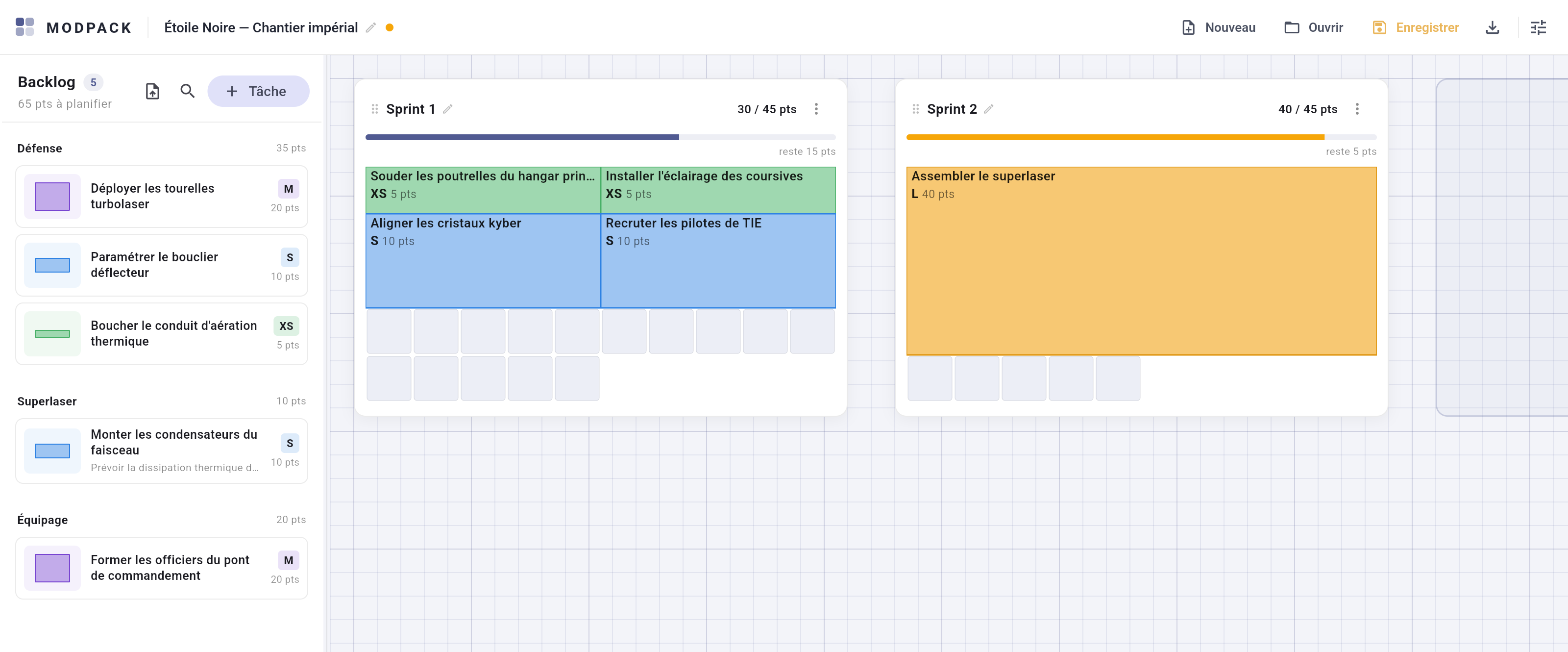
Like a moving box: the grid has a capacity, blocks have a volume, and you instantly see when it overflows. No table of numbers to decode — the visual is the information.
A 50-point sprint: 35 used, 15 free.
One cell is one point. A sprint with capacity 50 offers exactly 50 cells, ten per row.
A task takes as many cells as its estimation, in one piece, colored from green to red by size.
Planning is arranging. Drag a block: the grid announces in green, amber or red what will happen, before you even let go.
MODPACK is a planning tool, not a tracking one: no statuses, no dates, no accounts. The board is an infinite sheet where sprints sit as cards you move around as the workshop goes, link with dependencies — like the ones connecting the cards on this page — and fill by dragging blocks over from the backlog.
The estimation scale is yours: t-shirt, Fibonacci, hours, whatever your
team already uses. Your data flows freely, CSV in and CSV out, and the
whole project fits in a .modpack file you can read with
your own eyes. The rest you discover by playing — Tetris mode included.
Your data stays with you. Period.
MODPACK is local-first and non-commercial: free, under the MIT license, no ads, no paid tier. There is nothing to monetise, so nothing is collected — and nothing is sold.
- No account, no data server No sign-up, no database, no cloud. The app runs entirely in your browser.
- No tracking, no telemetry No analytics, no tracking cookies, no usage statistics — not in the app, not on this site.
-
Your projects = your files
Everything lives in a
.modpackfile (readable JSON) that only you hold. Nothing is sent to or kept on our servers.
app.modpack.fr — nothing to install, nothing to create.
Settings → "Tutorial" → "Load the sample project".
Arrange the blocks; "Save" downloads your .modpack
file.